William Shakespeare
3ms
William Shakespeare, born and raised in Stratford-upon-Avon, was an English playwright, poet, and actor. Widely regarded as the greatest writer in the English language and the world's pre-eminent dramatist, he's often called England's national poet and the "Bard of Avon." His extensive works, including collaborations, comprise around 39 plays, 154 sonnets, three long narrative poems, and other verses. His plays have been translated into every major living language and are performed more than any other playwright's. Shakespeare remains arguably the most influential writer in the English language, his works continuously studied and reinterpreted.
At 18, he married Anne Hathaway, with whom he had three children. Sometime between 1585 and 1592, he launched a successful career in London as an actor, writer, and part-owner of a playing company, later known as the King's Men. Around 1613, at 49, he appears to have retired to Stratford, where he died three years later. Few records of his private life survive, fueling speculation about his appearance, sexuality, beliefs, and even the authorship of his works.
Shakespeare produced most of his known works between 1589 and 1613. His early plays were primarily comedies and histories, considered masterpieces. He then focused on tragedies until 1608, including Hamlet, Othello, King Lear, and Macbeth, all celebrated as English classics. His final phase saw him writing tragicomedies, or romances, like The Winter's Tale and The Tempest, often in collaboration.
Many of his plays were published in varying editions during his lifetime. However, in 1623, John Heminges and Henry Condell, fellow actors and friends, published the definitive First Folio, a posthumous collection of 36 plays. Its preface featured a prescient poem by Ben Jonson, hailing Shakespeare as "not of an age, but for all time."
Shakespeare was the son of John Shakespeare, an alderman and glover, and Mary Arden, from an affluent landowning family. Baptised on April 26, 1564, his birth date is traditionally observed on April 23, Saint George's Day, also his death anniversary in 1616. He was the third of eight children and the eldest surviving son.
Though no attendance records survive, biographers agree he likely attended the King's New School in Stratford, a free grammar school. At 18, Shakespeare married the 26-year-old Anne Hathaway. A marriage license was issued on November 27, 1582, with the ceremony possibly arranged in haste. Six months later, their daughter Susanna was baptised. Twins, Hamnet and Judith, followed nearly two years later. Hamnet died at 11.
After the twins' birth, Shakespeare left few historical traces until his mention in the London theatre scene in 1592. The years between 1585 and 1592 are referred to as his "lost years," with many apocryphal stories surrounding this period, including tales of fleeing prosecution for deer poaching or starting his theatrical career minding horses.
It's unknown exactly when Shakespeare began writing, but contemporary records show several plays on the London stage by 1592. By then, he was notable enough to be attacked in print by playwright Robert Greene, who accused him of exceeding his rank. Greene's attack is the earliest surviving mention of Shakespeare's theatrical work. After 1594, Shakespeare's plays were performed by the Lord Chamberlain's Men, which became the leading playing company in London. After Queen Elizabeth's death in 1603, they became the King's Men.
In 1599, the company built their own theatre, the Globe, and in 1608, they took over the Blackfriars indoor theatre. Shakespeare's property purchases and investments indicate his association with the company made him wealthy. He bought New Place, the second-largest house in Stratford, in 1597.
Some of Shakespeare's plays were published in quarto editions from 1594, and by 1598, his name was a selling point on title pages. He continued to act in his own and others' plays. The First Folio of 1623 lists him as one of "the Principal Actors in all these Plays." Throughout his career, he divided his time between London and Stratford.
Nicholas Rowe, Shakespeare's first biographer, recorded the tradition that Shakespeare retired to Stratford "some years before his death." He was still acting in London in 1608. While retirement from all work was uncommon then, Shakespeare continued to visit London until around 1614. After 1610, he wrote fewer plays, with his last three being collaborations, likely with John Fletcher. He retired in 1613, before the Globe Theatre burned down.
Shakespeare died on April 23, 1616, at 52. No contemporary source explains his death, though John Ward, vicar of Stratford, later wrote of a merry meeting with Drayton and Jonson where Shakespeare "drank too hard, for Shakespeare died of a fever there contracted." He was survived by his wife and two daughters.
Shakespeare was buried in the chancel of the Holy Trinity Church. His epitaph includes a curse against disturbing his bones. A funerary monument was erected in his memory, comparing him to Nestor, Socrates, and Virgil. The Droeshout engraving, published with the First Folio, is another famous commemoration.
Most playwrights of the period collaborated, as did Shakespeare, mostly early and late in his career. His first recorded works, Richard III and the three parts of Henry VI, were written in the early 1590s. His early plays were influenced by other Elizabethan dramatists and medieval drama. His early comedies, like A Midsummer Night's Dream and The Merchant of Venice, are renowned for their romance and wit. He then introduced prose comedy into histories like Henry IV, Part 1 and 2, and Henry V, featuring the complex character of Falstaff. This period also produced tragedies like Romeo and Juliet and Julius Caesar.
In the early 17th century, Shakespeare wrote the so-called "problem plays" and his best-known tragedies. Hamlet, Othello, King Lear, and Macbeth are considered peaks of his art. His fatal flaws and errors of judgment drive the tragic plots. His last major tragedies, Antony and Cleopatra and Coriolanus, contain some of his finest poetry.
In his final period, Shakespeare turned to romance or tragicomedy, completing Cymbeline, The Winter's Tale, and The Tempest, along with the collaboration Pericles, Prince of Tyre. These plays, while graver than comedies, end with reconciliation. He collaborated on two further plays, Henry VIII and The Two Noble Kinsmen, likely with John Fletcher.
Shakespeare's works include the 36 plays printed in the First Folio, classified as comedies, histories, and tragedies. Pericles and The Two Noble Kinsmen are now accepted as part of his canon. The late comedies are sometimes classified as romances or tragicomedies, and four plays are termed "problem plays" due to their singular themes.
It's unclear for which companies Shakespeare wrote his early plays. After the plagues of 1592–93, his plays were performed by his own company at The Theatre and the Curtain. When disputes arose with their landlord, they dismantled The Theatre and built the Globe Theatre on the south bank of the Thames. Most of Shakespeare's greatest post-1599 plays were written for the Globe.
After the Lord Chamberlain's Men became the King's Men in 1603, they performed at court for King James. After 1608, they performed at the indoor Blackfriars Theatre in winter and the Globe in summer, allowing for more elaborate stage devices.
The actors in Shakespeare's company included Richard Burbage, who played leading roles in many of his plays, and comic actors like Will Kempe and Robert Armin. On June 29, 1613, a cannon set fire to the Globe's thatch, burning the theatre down during a performance of Henry VIII.
In 1623, John Heminges and Henry Condell published the First Folio, containing 36 plays, 18 printed for the first time. Many others had appeared in "bad quarto" versions, which were often adapted or garbled. Where multiple versions of a play survive, they can differ significantly, sometimes due to Shakespeare's own revisions.
In 1593 and 1594, during theatre closures due to plague, Shakespeare published two narrative poems on sexual themes, Venus and Adonis and The Rape of Lucrece, dedicated to Henry Wriothesley. A third poem, A Lover's Complaint, was printed in the 1609 Sonnets. The Phoenix and the Turtle appeared in 1601. Two early drafts of sonnets 138 and 144 appeared without his permission in The Passionate Pilgrim in 1599.
Published in 1609, the Sonnets were Shakespeare's last non-dramatic works to be printed. Composed throughout his career for a private readership, they are believed to form two contrasting series: one about uncontrollable lust for a dark-complexioned married woman, and one about conflicted love for a fair young man. The dedication to "Mr. W.H." remains a mystery. The Sonnets are praised as a profound meditation on love, passion, procreation, death, and time.
Shakespeare's early plays used a stylized language, often rhetorical. He soon adapted traditional styles, blending them with freer approaches. By the mid-1590s, with plays like Romeo and Juliet, he wrote more natural poetry, tuning metaphors to the drama's needs. His standard form was blank verse, iambic pentameter, which he varied and interrupted for dramatic effect, particularly in the late tragedies, creating a more concentrated, rapid, and elliptical style. He combined poetic genius with a practical sense of theatre, reshaping stories to create multiple centres of interest and show as many sides of a narrative as possible.
Shakespeare's work has made a significant and lasting impression on later theatre and literature, expanding the dramatic potential of characterisation, plot, language, and genre. His work heavily influenced later poetry and novelists. He inspired thousands of musical pieces, operas, paintings, and films. In his day, English grammar, spelling, and pronunciation were less standardized, and his use of language helped shape modern English. Expressions like "with bated breath" and "a foregone conclusion" are now everyday phrases.
Shakespeare's influence extends globally. His reception in Germany was particularly significant, where he became a "classic of the German Weimar era." His universal appeal has led different cultures to embrace his work, liberating writers across the continent. He remains the world's best-selling playwright and the third most translated author in history.
Shakespeare was not revered in his lifetime but received considerable praise. Ben Jonson called him "the Soul of the age, the applause, delight, the wonder of our stage." Between the Restoration and the late 17th century, critics often rated him below Fletcher and Jonson. However, John Dryden rated Shakespeare highly, stating, "I admire him, but I love Shakespeare." During the 18th century, critics began to acclaim his natural genius, leading to scholarly editions and his firm establishment as the national poet, the "Bard of Avon." His reputation spread abroad, championed by writers like Voltaire and Victor Hugo.
During the Romantic era, he was praised by Samuel Taylor Coleridge and translated by August Wilhelm Schlegel. In the 19th century, admiration bordered on adulation. The Victorians produced his plays as grand spectacles. George Bernard Shaw mocked this "bardolatry," claiming Ibsen's plays made Shakespeare obsolete. Modernists eagerly enlisted his work, and Bertolt Brecht devised epic theatre under his influence. T. S. Eliot argued for Shakespeare's modern relevance, leading a movement towards closer readings of his imagery. Harold Bloom wrote, "Shakespeare was larger than Plato and than St. Augustine. He encloses us because we see with his fundamental perceptions."
Around 230 years after his death, doubts arose about the authorship of his works, with proposed alternative candidates including Francis Bacon, Christopher Marlowe, and Edward de Vere. While most scholars consider these fringe theories, interest persists.
Shakespeare conformed to the state religion, but his private religious views are debated. His will uses a Protestant formula, and he was a member of the Church of England. Some scholars believe his family were Catholics, a difficult time for practising the faith. Evidence for his mother's Catholic family exists, and a statement of faith attributed to his father is cited, though its authenticity is debated. His daughter Susanna's name appears on a list of those who failed to attend Easter communion. The truth of his religious beliefs remains unprovable.
Few details of Shakespeare's sexuality are known. His marriage to Anne Hathaway, who was pregnant, and the birth of their children are documented. Some readers interpret his sonnets as autobiographical evidence of love for a young man, while others see them as expressions of intense friendship. The "Dark Lady" sonnets are seen as evidence of heterosexual liaisons.
No contemporary written description of Shakespeare's physical appearance survives, and no evidence suggests he commissioned a portrait. The desire for authentic portraits led to claims, fakes, and misattributions. The Droeshout portrait and his Stratford monument are considered the best evidence of his appearance, with the Chandos portrait having a strong claim.
Shakespeare's work has made a significant and lasting impression on later theatre and literature. He expanded the dramatic potential of characterisation, plot, language, and genre. His work heavily influenced later poetry, novelists, music, painting, film, and even psychoanalysis. His use of language helped shape modern English, contributing expressions still in use today. His influence extends far beyond England, embraced by cultures worldwide as he offers "something for everyone." He remains the world's best-selling playwright and the third most translated author in history.
Shakespeare was not revered in his lifetime but received considerable praise. Ben Jonson called him "the Soul of the age, the applause, delight, the wonder of our stage." Between the Restoration and the late 17th century, critics often rated him below Fletcher and Jonson. However, John Dryden rated Shakespeare highly, stating, "I admire him, but I love Shakespeare." During the 18th century, critics began to acclaim his natural genius, leading to scholarly editions and his firm establishment as the national poet, the "Bard of Avon." His reputation spread abroad, championed by writers like Voltaire and Victor Hugo.
During the Romantic era, he was praised by Samuel Taylor Coleridge and translated by August Wilhelm Schlegel. In the 19th century, admiration bordered on adulation. The Victorians produced his plays as grand spectacles. George Bernard Shaw mocked this "bardolatry," claiming Ibsen's plays made Shakespeare obsolete. Modernists eagerly enlisted his work, and Bertolt Brecht devised epic theatre under his influence. T. S. Eliot argued for Shakespeare's modern relevance, leading a movement towards closer readings of his imagery. Harold Bloom wrote, "Shakespeare was larger than Plato and than St. Augustine. He encloses us because we see with his fundamental perceptions."
Around 230 years after his death, doubts arose about the authorship of his works, with proposed alternative candidates including Francis Bacon, Christopher Marlowe, and Edward de Vere. While most scholars consider these fringe theories, interest persists.
Shakespeare conformed to the state religion, but his private religious views are debated. His will uses a Protestant formula, and he was a member of the Church of England. Some scholars believe his family were Catholics, a difficult time for practising the faith. Evidence for his mother's Catholic family exists, and a statement of faith attributed to his father is cited, though its authenticity is debated. His daughter Susanna's name appears on a list of those who failed to attend Easter communion. The truth of his religious beliefs remains unprovable.
Few details of Shakespeare's sexuality are known. His marriage to Anne Hathaway, who was pregnant, and the birth of their children are documented. Some readers interpret his sonnets as autobiographical evidence of love for a young man, while others see them as expressions of intense friendship. The "Dark Lady" sonnets are seen as evidence of heterosexual liaisons.
No contemporary written description of Shakespeare's physical appearance survives, and no evidence suggests he commissioned a portrait. The desire for authentic portraits led to claims, fakes, and misattributions. The Droeshout portrait and his Stratford monument are considered the best evidence of his appearance, with the Chandos portrait having a strong claim.
Copied!
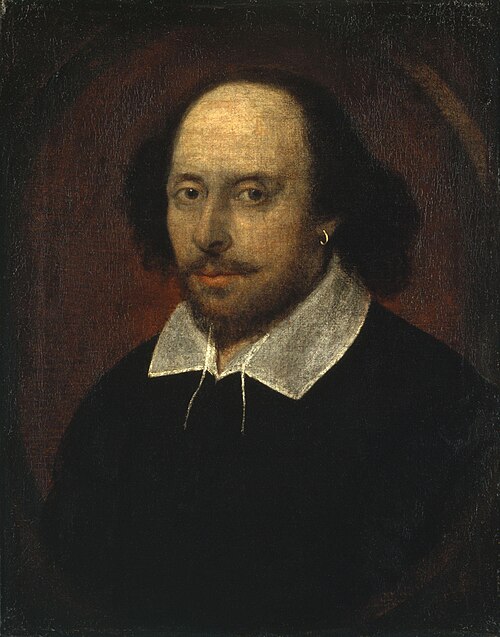 William Shakespeare (c. 23 April 1564 – 23 April 1616) was an English playwright, poet and actor. He is widely regarded as the greatest writer in the English language and the world's pre-eminent dramatist. He is often called England's national poet and the "Bard of Avon" or simply "the Bard". His extant works, including collaborations, consist of some 39 plays, 154 sonnets, three long narrative poems and a few other verses, some of uncertain authorship. His plays have been translated into every major living language and are performed more often than those of any other playwright. Shakespeare remains arguably the most influential writer in the English language, and his works continue to be studied and reinterpreted.
Shakespeare was born and raised in Stratford-upon-Avon, Warwickshire. At the age of 18, he married Anne Hathaway, with whom he had three children: Susanna, and twins Hamnet and Judith. Sometime between 1585 and 1592 he began a successful career in London as an actor, writer, and part-owner ("sharer") of a playing company called the Lord Chamberlain's Men, later known as the King's Men after the ascension of King James VI of Scotland to the English throne. At age 49 (around 1613) he appears to have retired to Stratford, where he died three years later. Few records of Shakespeare's private life survive; this has stimulated considerable speculation about such matters as his physical appearance, his sexuality, his religious beliefs and even certain fringe theories as to whether the works attributed to him were written by others.
Shakespeare produced most of his known works between 1589 and 1613. His early plays were primarily comedies and histories and are regarded as some of the best works produced in these genres. He then wrote mainly tragedies until 1608, among them Hamlet, Othello, King Lear and Macbeth, all considered to be among the finest works in English. In the last phase of his life he wrote tragicomedies (also known as romances) such as The Winter's Tale and The Tempest, and collaborated with other playwrights.
Many of Shakespeare's plays were published in editions of varying quality and accuracy during his lifetime. However, in 1623 John Heminges and Henry Condell, two fellow actors and friends of Shakespeare's, published a more definitive text known as the First Folio, a posthumous collected edition of Shakespeare's dramatic works that includes 36 of his plays. Its preface includes a prescient poem by Ben Jonson, a former rival of Shakespeare, who hailed Shakespeare with the now-famous epithet: "not of an age, but for all time".
== Life ==
=== Early life ===
Shakespeare was the son of John Shakespeare, an alderman and a successful glover (glove-maker) originally from Snitterfield in Warwickshire, and Mary Arden, the daughter of an affluent landowning family. He was born in Stratford-upon-Avon, where he was baptised on 26 April 1564. His date of birth is unknown but is traditionally observed on 23 April, Saint George's Day. This date, which can be traced to William Oldys and George Steevens, has proved appealing to biographers because Shakespeare died on the same date in 1616. He was the third of eight children, and the eldest surviving son.
Although no attendance records for the period survive, most biographers agree that Shakespeare was probably educated at the King's New School in Stratford, a free school chartered in 1553, about a quarter-mile (400 m) from his home. Grammar schools varied in quality during the Elizabethan era, but grammar school curricula were largely similar: the basic Latin text was standardised by royal decree, and the school would have provided an intensive education in grammar based upon Latin classical authors.
At the age of 18, Shakespeare married 26-year-old Anne Hathaway. The consistory court of the Diocese of Worcester issued a marriage licence on 27 November 1582. The next day, two of Hathaway's neighbours posted bonds guaranteeing that no lawful claims impeded the marriage. The ceremony may have been arranged in some haste; the Worcester chancellor allowed the marriage banns to be read once instead of the usual three times. Six months after the marriage, Anne gave birth to a daughter, Susanna, baptised 26 May 1583. Twins, son Hamnet and daughter Judith, followed almost two years later and were baptised 2 February 1585. Hamnet died of unknown causes at the age of 11 and was buried 11 August 1596.
After the birth of the twins, Shakespeare left few historical traces until he is mentioned as part of the London theatre scene in 1592. The exception is the appearance of his name in the "complaints bill" of a law case before the Queen's Bench court at Westminster dated Michaelmas Term 1588 and 9 October 1589. Scholars refer to the years between 1585 and 1592 as Shakespeare's "lost years". Biographers attempting to account for this period have reported many apocryphal stories. Nicholas Rowe, Shakespeare's first biographer, recounted a Stratford legend that Shakespeare fled the town for London to escape prosecution for deer poaching in the estate of local squire Thomas Lucy. Shakespeare is also supposed to have taken his revenge on Lucy by writing a scurrilous ballad about him. Another 18th-century story has Shakespeare starting his theatrical career minding the horses of theatre patrons in London. John Aubrey reported that Shakespeare had been a country schoolmaster. Some 20th-century scholars suggested that Shakespeare may have been employed as a schoolmaster by Alexander Hoghton of Lancashire, a Catholic landowner who named a certain "William Shakeshafte" in his will. Little evidence substantiates such stories other than hearsay collected after his death, and Shakeshafte was a common name in the Lancashire area.
=== London and theatrical career ===
It is not known definitively when Shakespeare began writing, but contemporary allusions and records of performances show that several of his plays were on the London stage by 1592. By then, he was sufficiently known in London to be attacked in print by the playwright Robert Greene in his Groats-Worth of Wit from that year:
... there is an upstart Crow, beautified with our feathers, that with his Tiger's heart wrapped in a Player's hide, supposes he is as well able to bombast out a blank verse as the best of you: and being an absolute Johannes factotum, is in his own conceit the only Shake-scene in a country.
Scholars differ on the exact meaning of Greene's words, but most agree that Greene was accusing Shakespeare of reaching above his rank in trying to match such university-educated writers as Christopher Marlowe, Thomas Nashe and Greene himself (the so-called "University Wits"). The italicised phrase parodying the line "Oh, tiger's heart wrapped in a woman's hide" from Shakespeare's Henry VI, Part 3, along with the pun "Shake-scene", clearly identify Shakespeare as Greene's target. As used here, Johannes Factotum ("Jack of all trades") refers to a second-rate tinkerer with the work of others, rather than the more common "universal genius".
Greene's attack is the earliest surviving mention of Shakespeare's work in the theatre. Biographers suggest that his career may have begun any time from the mid-1580s to just before Greene's remarks. After 1594 Shakespeare's plays were performed at The Theatre, in Shoreditch, only by the Lord Chamberlain's Men, a company owned by a group of players, including Shakespeare, that soon became the leading playing company in London. After the death of Queen Elizabeth in 1603, the company was awarded a royal patent by the new King James I, and changed its name to the King's Men.
In 1599 a partnership of members of the company built their own theatre on the south bank of the River Thames, which they named the Globe. In 1608 the partnership also took over the Blackfriars indoor theatre. Extant records of Shakespeare's property purchases and investments indicate that his association with the company made him a wealthy man, and in 1597 he bought the second-largest house in Stratford, New Place, and in 1605 invested in a share of the parish tithes in Stratford.
Some of Shakespeare's plays were published in quarto editions, beginning in 1594, and by 1598 his name had become a selling point and began to appear on the title pages. Shakespeare continued to act in his own and other plays after his success as a playwright. The 1616 edition of Ben Jonson's Works names him on the cast lists for Every Man in His Humour (1598) and Sejanus His Fall (1603). The absence of his name from the 1605 cast list for Jonson's Volpone is taken by some scholars as a sign that his acting career was nearing its end. The First Folio of 1623, however, lists Shakespeare as one of "the Principal Actors in all these Plays", some of which were first staged after Volpone, although one cannot know for certain which roles he played. In 1610, John Davies of Hereford wrote that "good Will" played "kingly" roles. In 1709 Rowe passed down a tradition that Shakespeare played the ghost of Hamlet's father. Later traditions maintain that he also played Adam in As You Like It, and the Chorus in Henry V, though scholars doubt the sources of that information.
Throughout his career, Shakespeare divided his time between London and Stratford. In 1596, the year before he bought New Place as his family home in Stratford, Shakespeare was living in the parish of St Helen's, Bishopsgate, north of the River Thames. He moved across the river to Southwark by 1599, the same year his company constructed the Globe Theatre there. By 1604 he had moved north of the river again, to an area north of St Paul's Cathedral with many fine houses. There he rented rooms from a French Huguenot named Christopher Mountjoy, a maker of women's wigs and other headgear.
=== Later years and death ===
Nicholas Rowe was the first biographer to record the tradition, repeated by Samuel Johnson, that Shakespeare retired to Stratford "some years before his death". He was still working as an actor in London in 1608; in an answer to the sharers' petition in 1635, Cuthbert Burbage stated that after purchasing the lease of the Blackfriars Theatre in 1608 from Henry Evans, the King's Men "placed men players" there, "which were Heminges, Condell, Shakespeare, etc.". However, it is perhaps relevant that the bubonic plague raged in London throughout 1609. The London public playhouses were repeatedly closed during extended outbreaks of the plague (a total of over 60 months closure between May 1603 and February 1610), which meant there was often no acting work. Retirement from all work was uncommon at that time. Shakespeare continued to visit London during the years 1611–1614. In 1612 he was called as a witness in Bellott v Mountjoy, a court case concerning the marriage settlement of Mountjoy's daughter, Mary. In March 1613 he bought a gatehouse in the former Blackfriars priory; and from November 1614 he was in London for several weeks with his son-in-law, John Hall. After 1610 Shakespeare wrote fewer plays, and none are attributed to him after 1613. His last three plays were collaborations, probably with John Fletcher, who succeeded him as the house playwright of the King's Men. He retired in 1613, before the Globe Theatre burned down during the performance of Henry VIII on 29 June.
Shakespeare died on 23 April 1616, at the age of 52. He died within a month of signing his will, a document which he begins by describing himself as being in "perfect health". No extant contemporary source explains how or why he died. Half a century later, John Ward, the vicar of Stratford, wrote in his notebook: "Shakespeare, Drayton, and Ben Jonson had a merry meeting and, it seems, drank too hard, for Shakespeare died of a fever there contracted", not an impossible scenario since Shakespeare knew Jonson and Michael Drayton. Of the tributes from fellow authors, one refers to his relatively sudden death: "We wondered, Shakespeare, that thou went'st so soon / From the world's stage to the grave's tiring room."
He was survived by his wife and two daughters. Susanna had married a physician, John Hall, in 1607, and Judith had married Thomas Quiney, a vintner, two months before Shakespeare's death. Shakespeare signed his last will and testament on 25 March 1616; the following day, Thomas Quiney, his new son-in-law, was found guilty of fathering an illegitimate son by Margaret Wheeler, both of whom had died during childbirth. Thomas was ordered by the church court to do public penance, which would have caused much shame and embarrassment for the Shakespeare family.
Shakespeare bequeathed the bulk of his large estate to his elder daughter Susanna under stipulations that she pass it down intact to "the first son of her body". The Quineys had three children, all of whom died without marrying. The Halls had one child, Elizabeth, who married twice but died without children in 1670, ending Shakespeare's direct line. Shakespeare's will scarcely mentions his wife, Anne, who was probably entitled to one-third of his estate automatically. He did make a point, however, of leaving her "my second best bed", a bequest that has led to much speculation. Some scholars see the bequest as an insult to Anne, whereas others believe that the second-best bed would have been the matrimonial bed and therefore rich in significance.
Shakespeare was buried in the chancel of the Holy Trinity Church two days after his death. The epitaph carved into the stone slab covering his grave includes a curse against moving his bones, which was carefully avoided during restoration of the church in 2008:
Some time before 1623 a funerary monument was erected in his memory on the north wall, with a half-effigy of him in the act of writing. Its plaque compares him to Nestor, Socrates, and Virgil. In 1623, in conjunction with the publication of the First Folio, the Droeshout engraving was published. Shakespeare has been commemorated in many statues and memorials around the world, including funeral monuments in Southwark Cathedral and Poets' Corner in Westminster Abbey.
== Plays ==
Most playwrights of the period typically collaborated with others at some point, as critics agree Shakespeare did, mostly early and late in his career.
The first recorded works of Shakespeare are Richard III and the three parts of Henry VI, written in the early 1590s during a vogue for historical drama. Shakespeare's plays are difficult to date precisely, however, and studies of the texts suggest that Titus Andronicus, The Comedy of Errors, The Taming of the Shrew, and The Two Gentlemen of Verona may also belong to Shakespeare's earliest period. His first histories, which draw heavily on the 1587 edition of Raphael Holinshed's Chronicles of England, Scotland, and Ireland, dramatise the destructive results of weak or corrupt rule and have been interpreted as a justification for the origins of the Tudor dynasty. The early plays were influenced by the works of other Elizabethan dramatists, especially Thomas Kyd and Christopher Marlowe, by the traditions of medieval drama, and by the plays of Seneca. The Comedy of Errors was also based on classical models, but no source for The Taming of the Shrew has been found, though it has an identical plot but different wording as another play with a similar name. Like The Two Gentlemen of Verona, in which two friends appear to approve of rape, the Shrew's story of the taming of a woman's independent spirit by a man sometimes troubles modern critics, directors, and audiences.
Shakespeare's early classical and Italianate comedies, containing tight double plots and precise comic sequences, give way in the mid-1590s to the romantic atmosphere of his most acclaimed comedies. A Midsummer Night's Dream is a witty mixture of romance, fairy magic, and comic lowlife scenes. Shakespeare's next comedy, the equally romantic The Merchant of Venice, contains a portrayal of the vengeful Jewish moneylender Shylock, which reflects dominant Elizabethan views but may appear derogatory to modern audiences. The wit and wordplay of Much Ado About Nothing, the charming rural setting of As You Like It, and the lively merrymaking of Twelfth Night complete Shakespeare's sequence of great comedies. After the lyrical Richard II, written almost entirely in verse, Shakespeare introduced prose comedy into the histories of the late 1590s, Henry IV, Part 1 and 2, and Henry V. Henry IV features Falstaff, rogue, wit and friend of Prince Hal. His characters become more complex and tender as he switches deftly between comic and serious scenes, prose and poetry, and achieves the narrative variety of his mature work. This period begins and ends with two tragedies: Romeo and Juliet, the famous romantic tragedy of sexually charged adolescence, love, and death; and Julius Caesar—based on Sir Thomas North's 1579 translation of Plutarch's Parallel Lives—which introduced a new kind of drama. According to the Shakespearean scholar James Shapiro, in Julius Caesar, "the various strands of politics, character, inwardness, contemporary events, even Shakespeare's own reflections on the act of writing, began to infuse each other".
In the early-17th century, Shakespeare wrote the so-called "problem plays" Measure for Measure, Troilus and Cressida, and All's Well That Ends Well and a number of his best known tragedies. Many critics believe that Shakespeare's tragedies represent the peak of his art. Hamlet has probably been analysed more than any other Shakespearean character, especially for his famous soliloquy which begins "To be or not to be; that is the question". Unlike the introverted Hamlet, whose fatal flaw is hesitation, Othello and Lear are undone by hasty errors of judgement. The plots of Shakespeare's tragedies often hinge on such fatal errors or flaws, which overturn order and destroy the hero and those he loves. In Othello, Iago stokes Othello's sexual jealousy to the point where he murders the innocent wife who loves him. In King Lear, the old king commits the tragic error of giving up his powers, initiating the events which lead to the torture and blinding of the Earl of Gloucester and the murder of Lear's youngest daughter, Cordelia. According to the critic Frank Kermode, "the play...offers neither its good characters nor its audience any relief from its cruelty". In Macbeth, the shortest and most compressed of Shakespeare's tragedies, uncontrollable ambition incites Macbeth and his wife, Lady Macbeth, to murder the rightful king and usurp the throne until their own guilt destroys them in turn. In this play, Shakespeare adds a supernatural element to the tragic structure. His last major tragedies, Antony and Cleopatra and Coriolanus, contain some of Shakespeare's finest poetry and were considered his most successful tragedies by the poet and critic T. S. Eliot. Eliot wrote, "Shakespeare acquired more essential history from Plutarch than most men could from the whole British Museum."
In his final period, Shakespeare turned to romance or tragicomedy and completed three more major plays: Cymbeline, The Winter's Tale, and The Tempest, as well as the collaboration, Pericles, Prince of Tyre. Less bleak than the tragedies, these four plays are graver in tone than the comedies of the 1590s, but they end with reconciliation and the forgiveness of potentially tragic errors. Some commentators have seen this change in mood as evidence of a more serene view of life on Shakespeare's part, but it may merely reflect the theatrical fashion of the day. Shakespeare collaborated on two further surviving plays, Henry VIII and The Two Noble Kinsmen, probably with John Fletcher.
=== Classification ===
Shakespeare's works include the 36 plays printed in the First Folio of 1623, listed according to their folio classification as comedies, histories, and tragedies. Two plays not included in the First Folio, The Two Noble Kinsmen and Pericles, Prince of Tyre, are now accepted as part of the canon, with today's scholars agreeing that Shakespeare made major contributions to the writing of both. No Shakespearean poems were included in the First Folio, partly because the collection was compiled by men of theatre.
In the late 19th century the critic Edward Dowden classified four of the late comedies as romances, and though many scholars prefer to call them tragicomedies, Dowden's term is often used. In 1896 Frederick S. Boas coined the term "problem plays" to describe four plays: All's Well That Ends Well, Measure for Measure, Troilus and Cressida and Hamlet. "Dramas as singular in theme and temper cannot be strictly called comedies or tragedies", he wrote. "We may, therefore, borrow a convenient phrase from the theatre of today and class them together as Shakespeare's problem plays." The term, much debated and sometimes applied to other plays, remains in use, though Hamlet is definitively classed as a tragedy.
=== Performances ===
It is not clear for which companies Shakespeare wrote his early plays. The title page of the 1594 edition of Titus Andronicus reveals that the play had been acted by three different troupes. After the plagues of 1592–93, Shakespeare's plays were performed by his own company at The Theatre and the Curtain in Shoreditch, north of the Thames. Londoners flocked there to see the first part of Henry IV, Leonard Digges recording, "Let but Falstaff come, Hal, Poins, the rest ... and you scarce shall have a room". When the company found themselves in dispute with their landlord, they pulled The Theatre down and used the timbers to construct the Globe Theatre, the first playhouse built by actors for actors, on the south bank of the Thames at Southwark. The Globe opened in autumn 1599, with Julius Caesar one of the first plays staged. Most of Shakespeare's greatest post-1599 plays were written for the Globe, including Hamlet, Othello, and King Lear.
After the Lord Chamberlain's Men were renamed the King's Men in 1603, they entered a special relationship with the new King James. Although the performance records are patchy, the King's Men performed seven of Shakespeare's plays at court between 1 November 1604, and 31 October 1605, including two performances of The Merchant of Venice. After 1608, they performed at the indoor Blackfriars Theatre during the winter and the Globe during the summer. The indoor setting, combined with the Jacobean fashion for lavishly staged masques, allowed Shakespeare to introduce more elaborate stage devices. In Cymbeline, for example, Jupiter descends "in thunder and lightning, sitting upon an eagle: he throws a thunderbolt. The ghosts fall on their knees."
The actors in Shakespeare's company included the famous Richard Burbage, William Kempe, Henry Condell and John Heminges. Burbage played the leading role in the first performances of many of Shakespeare's plays, including Richard III, Hamlet, Othello, and King Lear. The popular comic actor Will Kempe played the servant Peter in Romeo and Juliet and Dogberry in Much Ado About Nothing, among other characters. He was replaced around 1600 by Robert Armin, who played roles such as Touchstone in As You Like It and the fool in King Lear. In 1613 Sir Henry Wotton recorded that Henry VIII "was set forth with many extraordinary circumstances of pomp and ceremony". However, on 29 June a cannon set fire to the thatch of the Globe and burned the theatre to the ground, an event that pinpoints the date of a Shakespeare play with rare precision.
=== Textual sources ===
In 1623 John Heminges and Henry Condell, two of Shakespeare's colleagues from the King's Men, published the First Folio, a collected edition of Shakespeare's plays. It contained 36 texts, including 18 printed for the first time. Most of the others had already appeared in quarto versions—flimsy books made from sheets of paper folded twice to make four leaves. No evidence suggests that Shakespeare approved these editions, which the First Folio describes as "stol'n and surreptitious copies".
Alfred Pollard termed some of the pre-1623 versions as "bad quartos" because of their adapted, paraphrased or garbled texts, which may in places have been reconstructed from memory. Where several versions of a play survive, each differs from the others. The differences may stem from copying or printing errors, from notes by actors or audience members, or from Shakespeare's own papers. In some cases, for example, Hamlet, Troilus and Cressida, and Othello, Shakespeare could have revised the texts between the quarto and folio editions. In the case of King Lear, however, while most modern editions do conflate them, the 1623 folio version is so different from the 1608 quarto that the Oxford Shakespeare prints them both, arguing that they cannot be conflated without confusion.
== Poems ==
In 1593 and 1594, when the theatres were closed because of plague, Shakespeare published two narrative poems on sexual themes, Venus and Adonis and The Rape of Lucrece. He dedicated them to Henry Wriothesley, 3rd Earl of Southampton. In Venus and Adonis, an innocent Adonis rejects the sexual advances of Venus; while in The Rape of Lucrece, the virtuous wife Lucrece is raped by the lustful Tarquin. Influenced by Ovid's Metamorphoses, the poems show the guilt and moral confusion that result from uncontrolled lust. Both proved popular and were often reprinted during Shakespeare's lifetime. A third narrative poem, A Lover's Complaint, in which a young woman laments her seduction by a persuasive suitor, was printed in the first edition of the Sonnets in 1609. Most scholars now accept that Shakespeare wrote A Lover's Complaint. Critics consider that its fine qualities are marred by leaden effects. The Phoenix and the Turtle, printed in Robert Chester's 1601 Love's Martyr, mourns the deaths of the legendary phoenix and his lover, the faithful turtle dove. In 1599, two early drafts of sonnets 138 and 144 appeared in The Passionate Pilgrim, published under Shakespeare's name but without his permission.
=== Sonnets ===
Published in 1609, the Sonnets were the last of Shakespeare's non-dramatic works to be printed. Scholars are not certain when each of the 154 sonnets was composed, but evidence suggests that Shakespeare wrote sonnets throughout his career for a private readership. Even before the two unauthorised sonnets appeared in The Passionate Pilgrim in 1599, Francis Meres had referred in 1598 to Shakespeare's "sugred Sonnets among his private friends". Few analysts believe that the published collection follows Shakespeare's intended sequence. He seems to have planned two contrasting series: one about uncontrollable lust for a married woman of dark complexion (the "dark lady"), and one about conflicted love for a fair young man (the "fair youth"). It remains unclear if these figures represent real individuals, or if the authorial "I" who addresses them represents Shakespeare himself, although William Wordsworth believed that with the sonnets "Shakespeare unlocked his heart".
The 1609 edition was dedicated to a "Mr. W.H.", credited as "the only begetter" of the poems. It is not known whether this was written by Shakespeare himself or by the publisher, Thomas Thorpe, whose initials appear at the foot of the dedication page; nor is it known who Mr. W.H. was, despite numerous theories, or whether Shakespeare even authorised the publication. Critics praise the Sonnets as a profound meditation on the nature of love, sexual passion, procreation, death, and time.
== Style ==
Shakespeare's first plays were written in the conventional style of the day. He wrote them in a stylised language that does not always spring naturally from the needs of the characters or the drama. The poetry depends on extended, sometimes elaborate metaphors and conceits, and the language is often rhetorical—written for actors to declaim rather than speak. The grand speeches in Titus Andronicus, in the view of some critics, often hold up the action, for example; and the verse in The Two Gentlemen of Verona has been described as stilted.
However, Shakespeare soon began to adapt the traditional styles to his own purposes. The opening soliloquy of Richard III has its roots in the self-declaration of Vice in medieval drama. At the same time, Richard's vivid self-awareness looks forward to the soliloquies of Shakespeare's mature plays. No single play marks a change from the traditional to the freer style. Shakespeare combined the two throughout his career, with Romeo and Juliet perhaps the best example of the mixing of the styles. By the time of Romeo and Juliet, Richard II and A Midsummer Night's Dream in the mid-1590s, Shakespeare had begun to write a more natural poetry. He increasingly tuned his metaphors and images to the needs of the drama itself.
Shakespeare's standard poetic form was blank verse, composed in iambic pentameter. In practice, this meant that his verse was usually unrhymed and consisted of ten syllables to a line, spoken with a stress on every second syllable. The blank verse of his early plays is quite different from that of his later ones. It is often beautiful, but its sentences tend to start, pause, and finish at the end of lines, with the risk of monotony. Once Shakespeare mastered traditional blank verse, he began to interrupt and vary its flow. This technique releases the new power and flexibility of the poetry in plays such as Julius Caesar and Hamlet. Shakespeare uses it, for example, to convey the turmoil in Hamlet's mind:
After Hamlet, Shakespeare varied his poetic style further, particularly in the more emotional passages of the late tragedies. The literary critic A. C. Bradley described this style as "more concentrated, rapid, varied, and, in construction, less regular, not seldom twisted or elliptical". In the last phase of his career, Shakespeare adopted many techniques to achieve these effects. These included run-on lines, irregular pauses and stops, and extreme variations in sentence structure and length. In Macbeth, for example, the language darts from one unrelated metaphor or simile to another: "was the hope drunk/ Wherein you dressed yourself?" (1.7.35–38); "... pity, like a naked new-born babe/ Striding the blast, or heaven's cherubim, hors'd/ Upon the sightless couriers of the air ..." (1.7.21–25). The listener is challenged to complete the sense. The late romances, with their shifts in time and surprising turns of plot, inspired a last poetic style in which long and short sentences are set against one another, clauses are piled up, subject and object are reversed, and words are omitted, creating an effect of spontaneity.
Shakespeare combined poetic genius with a practical sense of the theatre. Like all playwrights of the time, he dramatised stories from sources such as Plutarch and Raphael Holinshed. He reshaped each plot to create several centres of interest and to show as many sides of a narrative to the audience as possible. This strength of design ensures that a Shakespeare play can survive translation, cutting, and wide interpretation without loss to its core drama. As Shakespeare's mastery grew, he gave his characters clearer and more varied motivations and distinctive patterns of speech. He preserved aspects of his earlier style in the later plays, however. In Shakespeare's late romances, he deliberately returned to a more artificial style, which emphasised the illusion of theatre.
== Legacy ==
=== Influence ===
Shakespeare's work has made a significant and lasting impression on later theatre and literature. In particular, he expanded the dramatic potential of characterisation, plot, language, and genre. Until Romeo and Juliet, for example, romance had not been viewed as a worthy topic for tragedy. Soliloquies had been used mainly to convey information about characters or events, but Shakespeare used them to explore characters' minds. His work heavily influenced later poetry. The Romantic poets attempted to revive Shakespearean verse drama, though with little success. The critic George Steiner described all English verse dramas from Samuel Taylor Coleridge to Alfred, Lord Tennyson, as "feeble variations on Shakespearean themes". John Milton, considered by many to be the most important English poet after Shakespeare, wrote in tribute: "Thou in our wonder and astonishment/ Hast built thyself a live-long monument."
Shakespeare influenced novelists such as Thomas Hardy, William Faulkner and Charles Dickens. The American novelist Herman Melville's soliloquies owe much to Shakespeare; his Captain Ahab in Moby-Dick is a classic tragic hero, inspired by King Lear. Scholars have identified 20,000 pieces of music linked to Shakespeare's works, including Felix Mendelssohn's overture and incidental music for A Midsummer Night's Dream and Sergei Prokofiev's ballet Romeo and Juliet. His work has inspired several operas, among them Giuseppe Verdi's Macbeth, Otello and Falstaff, whose critical standing compares with that of the source plays. Shakespeare has also inspired many painters, including the Romantics and the Pre-Raphaelites, while William Hogarth's 1745 painting of actor David Garrick playing Richard III was decisive in establishing the genre of theatrical portraiture in Britain. The Swiss Romantic artist Henry Fuseli, a friend of William Blake, even translated Macbeth into German. The psychoanalyst Sigmund Freud drew on Shakespearean psychology, in particular, that of Hamlet, for his theories of human nature. Shakespeare has been a rich source for filmmakers; Akira Kurosawa adapted Macbeth and King Lear as Throne of Blood and Ran. Other examples of Shakespeare on film include Max Reinhardt's A Midsummer Night's Dream, Laurence Olivier's Hamlet and Al Pacino's documentary Looking For Richard. Orson Welles, a lifelong lover of Shakespeare, directed and starred in Macbeth, Othello and Chimes at Midnight, in which he plays John Falstaff, which Welles himself called his best work.
In Shakespeare's day English grammar, spelling and pronunciation were less standardised than they are now, and his use of language helped to shape modern English. Samuel Johnson quoted him more often than any other author in his A Dictionary of the English Language, the first serious work of its type. Expressions such as "with bated breath" (Merchant of Venice) and "a foregone conclusion" (Othello) have found their way into everyday English speech.
Shakespeare's influence extends far beyond his native England and the English language. His reception in Germany was particularly significant; as early as the 18th century Shakespeare was widely translated and popularised in Germany, and gradually became a "classic of the German Weimar era;" Christoph Martin Wieland was the first to produce complete translations of Shakespeare's plays in any language. The actor and theatre-director Simon Callow writes, "this master, this titan, this genius, so profoundly British and so effortlessly universal, each different culture – German, Italian, Russian – was obliged to respond to the Shakespearean example; for the most part, they embraced it, and him, with joyous abandon, as the possibilities of language and character in action that he celebrated liberated writers across the continent. Some of the most deeply affecting productions of Shakespeare have been non-English, and non-European. He is that unique writer: he has something for everyone."
According to Guinness World Records Shakespeare remains the world's best-selling playwright, with sales of his plays and poetry believed to have achieved in excess of four billion copies in the almost 400 years since his death. He is also the third most translated author in history.
=== Critical reputation ===
Shakespeare was not revered in his lifetime, but he received a large amount of praise. In 1598 the cleric and author Francis Meres singled him out from a group of English playwrights as "the most excellent" in both comedy and tragedy. The authors of the Parnassus plays at St John's College, Cambridge, numbered him with Geoffrey Chaucer, John Gower and Edmund Spenser. In the First Folio, Ben Jonson called Shakespeare the "Soul of the age, the applause, delight, the wonder of our stage", although he had remarked elsewhere that "Shakespeare wanted art" (lacked skill).
Between the Restoration of the monarchy in 1660 and the end of the 17th century, classical ideas were in vogue. As a result, critics of the time mostly rated Shakespeare below John Fletcher and Ben Jonson. Thomas Rymer, for example, condemned Shakespeare for mixing the comic with the tragic. Nevertheless, the poet and critic John Dryden rated Shakespeare highly, saying of Jonson, "I admire him, but I love Shakespeare". He also famously remarked that Shakespeare "was naturally learned; he needed not the spectacles of books to read nature; he looked inwards, and found her there." For several decades, Rymer's view held sway. But during the 18th century, critics began to respond to Shakespeare on his own terms and, like Dryden, to acclaim what they termed his natural genius. A series of scholarly editions of his work, notably those of Samuel Johnson in 1765 and Edmond Malone in 1790, added to his growing reputation. By 1800, he was firmly enshrined as the national poet, and described as the "Bard of Avon" (or simply "the Bard"). In the 18th and 19th centuries, his reputation also spread abroad. Among those who championed him were the writers Voltaire, Johann Wolfgang Von Goethe, Stendhal and Victor Hugo.
During the Romantic era Shakespeare was praised by the poet and literary philosopher Samuel Taylor Coleridge, and the critic August Wilhelm Schlegel translated his plays in the spirit of German Romanticism. In the 19th century, critical admiration for Shakespeare's genius often bordered on adulation. "This King Shakespeare," the essayist Thomas Carlyle wrote in 1840, "does not he shine, in crowned sovereignty, over us all, as the noblest, gentlest, yet strongest of rallying signs; indestructible". The Victorians produced his plays as lavish spectacles on a grand scale. The playwright and critic George Bernard Shaw mocked the cult of Shakespeare worship as "bardolatry", claiming that the new naturalism of Henrik Ibsen's plays had made Shakespeare obsolete.
The modernist revolution in the arts during the early 20th century, far from discarding Shakespeare, eagerly enlisted his work in the service of the avant-garde. The Expressionists in Germany and the Futurists in Moscow mounted productions of his plays. The Marxist playwright and director Bertolt Brecht devised an epic theatre under the influence of Shakespeare. The poet and critic T. S. Eliot argued against Shaw that Shakespeare's "primitiveness" in fact made him truly modern. Eliot, along with G. Wilson Knight and the school of New Criticism, led a movement towards a closer reading of Shakespeare's imagery. In the 1950s, a wave of new critical approaches replaced modernism and paved the way for post-modern studies of Shakespeare. Comparing Shakespeare's accomplishments to those of leading figures in philosophy and theology, Harold Bloom wrote, "Shakespeare was larger than Plato and than St. Augustine. He encloses us because we see with his fundamental perceptions."
== Speculation ==
=== Authorship ===
Around 230 years after Shakespeare's death, doubts began to be expressed about the authorship of the works attributed to him. Proposed alternative candidates include Francis Bacon, Christopher Marlowe and Edward de Vere, 17th Earl of Oxford. Several "group theories" have also been proposed. All but a few Shakespeare scholars and literary historians consider it a fringe theory, with only a small minority of academics who believe that there is reason to question the traditional attribution, but interest in the subject, particularly the Oxfordian theory of Shakespeare authorship, continues into the 21st century.
=== Religion ===
Shakespeare conformed to the official state religion, but his private views on religion have been the subject of debate. Shakespeare's will uses a Protestant formula, and he was a confirmed member of the Church of England, where he was married, his children were baptised, and where he is buried.
Some scholars are of the view that members of Shakespeare's family were Catholics, at a time when practising Catholicism in England was against the law. Shakespeare's mother, Mary Arden, certainly came from a pious Catholic family. The strongest evidence might be a Catholic statement of faith signed by his father, John Shakespeare, found in 1757 in the rafters of his former house in Henley Street. However, the document is now lost and scholars differ as to its authenticity. In 1591 the authorities reported that John Shakespeare had missed church "for fear of process for debt", a common Catholic excuse. In 1606 the name of William's daughter Susanna appears on a list of those who failed to attend Easter communion in Stratford.
Other authors argue that there is a lack of evidence about Shakespeare's religious beliefs. Scholars find evidence both for and against Shakespeare's Catholicism, Protestantism, or lack of belief in his plays, but the truth may be impossible to prove.
In 1934, Rudyard Kipling published a short story in The Strand Magazine, "Proofs of Holy Writ", postulating that Shakespeare had helped to polish the prose of the King James Bible, published in 1611.
=== Sexuality ===
Few details of Shakespeare's sexuality are known. At 18 he married 26-year-old Anne Hathaway, who was pregnant. Susanna, the first of their three children, was born six months later on 26 May 1583. Over the centuries, some readers have posited that Shakespeare's sonnets are autobiographical, and point to them as evidence of his love for a young man. Others read the same passages as the expression of intense friendship rather than romantic love. The 26 so-called "Dark Lady" sonnets, addressed to a married woman, are taken as evidence of heterosexual liaisons.
=== Portraiture ===
No written contemporary description of Shakespeare's physical appearance survives, and no evidence suggests that he ever commissioned a portrait. From the 18th century, the desire for authentic Shakespeare portraits fuelled claims that various surviving pictures depicted Shakespeare. That demand also led to the production of several fake portraits, as well as misattributions, re-paintings, and relabelling of portraits of other people.
Some scholars suggest that the Droeshout portrait, which Ben Jonson approved of as a good likeness, and his Stratford monument provide perhaps the best evidence of his appearance. Of the claimed paintings, the art historian Tarnya Cooper concluded that the Chandos portrait had "the strongest claim of any of the known contenders to be a true portrait of Shakespeare". After a three-year study supported by the National Portrait Gallery, London, the portrait's owners, Cooper contended that its composition date, contemporary with Shakespeare, its subsequent provenance, and the sitter's attire, all supported the attribution.
== See also ==
Outline of William Shakespeare
English Renaissance theatre
Spelling of Shakespeare's name
World Shakespeare Bibliography
Shakespeare's Politics
== References ==
=== Notes ===
=== Citations ===
=== Sources ===
Books
Articles and online
== External links ==
Digital editions
William Shakespeare's plays on Bookwise
Internet Shakespeare Editions
The Folger Shakespeare
Open Source Shakespeare complete works, with search engine and concordance
The Shakespeare Quartos Archive
Works by William Shakespeare in eBook form at Standard Ebooks
Works by William Shakespeare at Project Gutenberg
Works by or about William Shakespeare at the Internet Archive
Works by William Shakespeare at LibriVox (public domain audiobooks)
Exhibitions
Shakespeare Documented an online exhibition documenting Shakespeare in his own time
Shakespeare's Will from The National Archives
The Shakespeare Birthplace Trust
William Shakespeare at the British Library. Archived 23 September 2021 at the Wayback Machine.
Music
Works by William Shakespeare set to music: free scores in the Choral Public Domain Library (ChoralWiki)
Works by William Shakespeare set to music: Scores at the International Music Score Library Project
Education
Shakespeare at Home an online resource providing free educational resources on William Shakespeare and the Renaissance world. Activities are dyslexia friendly and suitable for all ages.
Legacy and criticism
Records on Shakespeare's Theatre Legacy from the UK Parliamentary Collections
Winston Churchill & Shakespeare – UK Parliament Living Heritage
Home
Languages
William Shakespeare (c. 23 April 1564 – 23 April 1616) was an English playwright, poet and actor. He is widely regarded as the greatest writer in the English language and the world's pre-eminent dramatist. He is often called England's national poet and the "Bard of Avon" or simply "the Bard". His extant works, including collaborations, consist of some 39 plays, 154 sonnets, three long narrative poems and a few other verses, some of uncertain authorship. His plays have been translated into every major living language and are performed more often than those of any other playwright. Shakespeare remains arguably the most influential writer in the English language, and his works continue to be studied and reinterpreted.
Shakespeare was born and raised in Stratford-upon-Avon, Warwickshire. At the age of 18, he married Anne Hathaway, with whom he had three children: Susanna, and twins Hamnet and Judith. Sometime between 1585 and 1592 he began a successful career in London as an actor, writer, and part-owner ("sharer") of a playing company called the Lord Chamberlain's Men, later known as the King's Men after the ascension of King James VI of Scotland to the English throne. At age 49 (around 1613) he appears to have retired to Stratford, where he died three years later. Few records of Shakespeare's private life survive; this has stimulated considerable speculation about such matters as his physical appearance, his sexuality, his religious beliefs and even certain fringe theories as to whether the works attributed to him were written by others.
Shakespeare produced most of his known works between 1589 and 1613. His early plays were primarily comedies and histories and are regarded as some of the best works produced in these genres. He then wrote mainly tragedies until 1608, among them Hamlet, Othello, King Lear and Macbeth, all considered to be among the finest works in English. In the last phase of his life he wrote tragicomedies (also known as romances) such as The Winter's Tale and The Tempest, and collaborated with other playwrights.
Many of Shakespeare's plays were published in editions of varying quality and accuracy during his lifetime. However, in 1623 John Heminges and Henry Condell, two fellow actors and friends of Shakespeare's, published a more definitive text known as the First Folio, a posthumous collected edition of Shakespeare's dramatic works that includes 36 of his plays. Its preface includes a prescient poem by Ben Jonson, a former rival of Shakespeare, who hailed Shakespeare with the now-famous epithet: "not of an age, but for all time".
== Life ==
=== Early life ===
Shakespeare was the son of John Shakespeare, an alderman and a successful glover (glove-maker) originally from Snitterfield in Warwickshire, and Mary Arden, the daughter of an affluent landowning family. He was born in Stratford-upon-Avon, where he was baptised on 26 April 1564. His date of birth is unknown but is traditionally observed on 23 April, Saint George's Day. This date, which can be traced to William Oldys and George Steevens, has proved appealing to biographers because Shakespeare died on the same date in 1616. He was the third of eight children, and the eldest surviving son.
Although no attendance records for the period survive, most biographers agree that Shakespeare was probably educated at the King's New School in Stratford, a free school chartered in 1553, about a quarter-mile (400 m) from his home. Grammar schools varied in quality during the Elizabethan era, but grammar school curricula were largely similar: the basic Latin text was standardised by royal decree, and the school would have provided an intensive education in grammar based upon Latin classical authors.
At the age of 18, Shakespeare married 26-year-old Anne Hathaway. The consistory court of the Diocese of Worcester issued a marriage licence on 27 November 1582. The next day, two of Hathaway's neighbours posted bonds guaranteeing that no lawful claims impeded the marriage. The ceremony may have been arranged in some haste; the Worcester chancellor allowed the marriage banns to be read once instead of the usual three times. Six months after the marriage, Anne gave birth to a daughter, Susanna, baptised 26 May 1583. Twins, son Hamnet and daughter Judith, followed almost two years later and were baptised 2 February 1585. Hamnet died of unknown causes at the age of 11 and was buried 11 August 1596.
After the birth of the twins, Shakespeare left few historical traces until he is mentioned as part of the London theatre scene in 1592. The exception is the appearance of his name in the "complaints bill" of a law case before the Queen's Bench court at Westminster dated Michaelmas Term 1588 and 9 October 1589. Scholars refer to the years between 1585 and 1592 as Shakespeare's "lost years". Biographers attempting to account for this period have reported many apocryphal stories. Nicholas Rowe, Shakespeare's first biographer, recounted a Stratford legend that Shakespeare fled the town for London to escape prosecution for deer poaching in the estate of local squire Thomas Lucy. Shakespeare is also supposed to have taken his revenge on Lucy by writing a scurrilous ballad about him. Another 18th-century story has Shakespeare starting his theatrical career minding the horses of theatre patrons in London. John Aubrey reported that Shakespeare had been a country schoolmaster. Some 20th-century scholars suggested that Shakespeare may have been employed as a schoolmaster by Alexander Hoghton of Lancashire, a Catholic landowner who named a certain "William Shakeshafte" in his will. Little evidence substantiates such stories other than hearsay collected after his death, and Shakeshafte was a common name in the Lancashire area.
=== London and theatrical career ===
It is not known definitively when Shakespeare began writing, but contemporary allusions and records of performances show that several of his plays were on the London stage by 1592. By then, he was sufficiently known in London to be attacked in print by the playwright Robert Greene in his Groats-Worth of Wit from that year:
... there is an upstart Crow, beautified with our feathers, that with his Tiger's heart wrapped in a Player's hide, supposes he is as well able to bombast out a blank verse as the best of you: and being an absolute Johannes factotum, is in his own conceit the only Shake-scene in a country.
Scholars differ on the exact meaning of Greene's words, but most agree that Greene was accusing Shakespeare of reaching above his rank in trying to match such university-educated writers as Christopher Marlowe, Thomas Nashe and Greene himself (the so-called "University Wits"). The italicised phrase parodying the line "Oh, tiger's heart wrapped in a woman's hide" from Shakespeare's Henry VI, Part 3, along with the pun "Shake-scene", clearly identify Shakespeare as Greene's target. As used here, Johannes Factotum ("Jack of all trades") refers to a second-rate tinkerer with the work of others, rather than the more common "universal genius".
Greene's attack is the earliest surviving mention of Shakespeare's work in the theatre. Biographers suggest that his career may have begun any time from the mid-1580s to just before Greene's remarks. After 1594 Shakespeare's plays were performed at The Theatre, in Shoreditch, only by the Lord Chamberlain's Men, a company owned by a group of players, including Shakespeare, that soon became the leading playing company in London. After the death of Queen Elizabeth in 1603, the company was awarded a royal patent by the new King James I, and changed its name to the King's Men.
In 1599 a partnership of members of the company built their own theatre on the south bank of the River Thames, which they named the Globe. In 1608 the partnership also took over the Blackfriars indoor theatre. Extant records of Shakespeare's property purchases and investments indicate that his association with the company made him a wealthy man, and in 1597 he bought the second-largest house in Stratford, New Place, and in 1605 invested in a share of the parish tithes in Stratford.
Some of Shakespeare's plays were published in quarto editions, beginning in 1594, and by 1598 his name had become a selling point and began to appear on the title pages. Shakespeare continued to act in his own and other plays after his success as a playwright. The 1616 edition of Ben Jonson's Works names him on the cast lists for Every Man in His Humour (1598) and Sejanus His Fall (1603). The absence of his name from the 1605 cast list for Jonson's Volpone is taken by some scholars as a sign that his acting career was nearing its end. The First Folio of 1623, however, lists Shakespeare as one of "the Principal Actors in all these Plays", some of which were first staged after Volpone, although one cannot know for certain which roles he played. In 1610, John Davies of Hereford wrote that "good Will" played "kingly" roles. In 1709 Rowe passed down a tradition that Shakespeare played the ghost of Hamlet's father. Later traditions maintain that he also played Adam in As You Like It, and the Chorus in Henry V, though scholars doubt the sources of that information.
Throughout his career, Shakespeare divided his time between London and Stratford. In 1596, the year before he bought New Place as his family home in Stratford, Shakespeare was living in the parish of St Helen's, Bishopsgate, north of the River Thames. He moved across the river to Southwark by 1599, the same year his company constructed the Globe Theatre there. By 1604 he had moved north of the river again, to an area north of St Paul's Cathedral with many fine houses. There he rented rooms from a French Huguenot named Christopher Mountjoy, a maker of women's wigs and other headgear.
=== Later years and death ===
Nicholas Rowe was the first biographer to record the tradition, repeated by Samuel Johnson, that Shakespeare retired to Stratford "some years before his death". He was still working as an actor in London in 1608; in an answer to the sharers' petition in 1635, Cuthbert Burbage stated that after purchasing the lease of the Blackfriars Theatre in 1608 from Henry Evans, the King's Men "placed men players" there, "which were Heminges, Condell, Shakespeare, etc.". However, it is perhaps relevant that the bubonic plague raged in London throughout 1609. The London public playhouses were repeatedly closed during extended outbreaks of the plague (a total of over 60 months closure between May 1603 and February 1610), which meant there was often no acting work. Retirement from all work was uncommon at that time. Shakespeare continued to visit London during the years 1611–1614. In 1612 he was called as a witness in Bellott v Mountjoy, a court case concerning the marriage settlement of Mountjoy's daughter, Mary. In March 1613 he bought a gatehouse in the former Blackfriars priory; and from November 1614 he was in London for several weeks with his son-in-law, John Hall. After 1610 Shakespeare wrote fewer plays, and none are attributed to him after 1613. His last three plays were collaborations, probably with John Fletcher, who succeeded him as the house playwright of the King's Men. He retired in 1613, before the Globe Theatre burned down during the performance of Henry VIII on 29 June.
Shakespeare died on 23 April 1616, at the age of 52. He died within a month of signing his will, a document which he begins by describing himself as being in "perfect health". No extant contemporary source explains how or why he died. Half a century later, John Ward, the vicar of Stratford, wrote in his notebook: "Shakespeare, Drayton, and Ben Jonson had a merry meeting and, it seems, drank too hard, for Shakespeare died of a fever there contracted", not an impossible scenario since Shakespeare knew Jonson and Michael Drayton. Of the tributes from fellow authors, one refers to his relatively sudden death: "We wondered, Shakespeare, that thou went'st so soon / From the world's stage to the grave's tiring room."
He was survived by his wife and two daughters. Susanna had married a physician, John Hall, in 1607, and Judith had married Thomas Quiney, a vintner, two months before Shakespeare's death. Shakespeare signed his last will and testament on 25 March 1616; the following day, Thomas Quiney, his new son-in-law, was found guilty of fathering an illegitimate son by Margaret Wheeler, both of whom had died during childbirth. Thomas was ordered by the church court to do public penance, which would have caused much shame and embarrassment for the Shakespeare family.
Shakespeare bequeathed the bulk of his large estate to his elder daughter Susanna under stipulations that she pass it down intact to "the first son of her body". The Quineys had three children, all of whom died without marrying. The Halls had one child, Elizabeth, who married twice but died without children in 1670, ending Shakespeare's direct line. Shakespeare's will scarcely mentions his wife, Anne, who was probably entitled to one-third of his estate automatically. He did make a point, however, of leaving her "my second best bed", a bequest that has led to much speculation. Some scholars see the bequest as an insult to Anne, whereas others believe that the second-best bed would have been the matrimonial bed and therefore rich in significance.
Shakespeare was buried in the chancel of the Holy Trinity Church two days after his death. The epitaph carved into the stone slab covering his grave includes a curse against moving his bones, which was carefully avoided during restoration of the church in 2008:
Some time before 1623 a funerary monument was erected in his memory on the north wall, with a half-effigy of him in the act of writing. Its plaque compares him to Nestor, Socrates, and Virgil. In 1623, in conjunction with the publication of the First Folio, the Droeshout engraving was published. Shakespeare has been commemorated in many statues and memorials around the world, including funeral monuments in Southwark Cathedral and Poets' Corner in Westminster Abbey.
== Plays ==
Most playwrights of the period typically collaborated with others at some point, as critics agree Shakespeare did, mostly early and late in his career.
The first recorded works of Shakespeare are Richard III and the three parts of Henry VI, written in the early 1590s during a vogue for historical drama. Shakespeare's plays are difficult to date precisely, however, and studies of the texts suggest that Titus Andronicus, The Comedy of Errors, The Taming of the Shrew, and The Two Gentlemen of Verona may also belong to Shakespeare's earliest period. His first histories, which draw heavily on the 1587 edition of Raphael Holinshed's Chronicles of England, Scotland, and Ireland, dramatise the destructive results of weak or corrupt rule and have been interpreted as a justification for the origins of the Tudor dynasty. The early plays were influenced by the works of other Elizabethan dramatists, especially Thomas Kyd and Christopher Marlowe, by the traditions of medieval drama, and by the plays of Seneca. The Comedy of Errors was also based on classical models, but no source for The Taming of the Shrew has been found, though it has an identical plot but different wording as another play with a similar name. Like The Two Gentlemen of Verona, in which two friends appear to approve of rape, the Shrew's story of the taming of a woman's independent spirit by a man sometimes troubles modern critics, directors, and audiences.
Shakespeare's early classical and Italianate comedies, containing tight double plots and precise comic sequences, give way in the mid-1590s to the romantic atmosphere of his most acclaimed comedies. A Midsummer Night's Dream is a witty mixture of romance, fairy magic, and comic lowlife scenes. Shakespeare's next comedy, the equally romantic The Merchant of Venice, contains a portrayal of the vengeful Jewish moneylender Shylock, which reflects dominant Elizabethan views but may appear derogatory to modern audiences. The wit and wordplay of Much Ado About Nothing, the charming rural setting of As You Like It, and the lively merrymaking of Twelfth Night complete Shakespeare's sequence of great comedies. After the lyrical Richard II, written almost entirely in verse, Shakespeare introduced prose comedy into the histories of the late 1590s, Henry IV, Part 1 and 2, and Henry V. Henry IV features Falstaff, rogue, wit and friend of Prince Hal. His characters become more complex and tender as he switches deftly between comic and serious scenes, prose and poetry, and achieves the narrative variety of his mature work. This period begins and ends with two tragedies: Romeo and Juliet, the famous romantic tragedy of sexually charged adolescence, love, and death; and Julius Caesar—based on Sir Thomas North's 1579 translation of Plutarch's Parallel Lives—which introduced a new kind of drama. According to the Shakespearean scholar James Shapiro, in Julius Caesar, "the various strands of politics, character, inwardness, contemporary events, even Shakespeare's own reflections on the act of writing, began to infuse each other".
In the early-17th century, Shakespeare wrote the so-called "problem plays" Measure for Measure, Troilus and Cressida, and All's Well That Ends Well and a number of his best known tragedies. Many critics believe that Shakespeare's tragedies represent the peak of his art. Hamlet has probably been analysed more than any other Shakespearean character, especially for his famous soliloquy which begins "To be or not to be; that is the question". Unlike the introverted Hamlet, whose fatal flaw is hesitation, Othello and Lear are undone by hasty errors of judgement. The plots of Shakespeare's tragedies often hinge on such fatal errors or flaws, which overturn order and destroy the hero and those he loves. In Othello, Iago stokes Othello's sexual jealousy to the point where he murders the innocent wife who loves him. In King Lear, the old king commits the tragic error of giving up his powers, initiating the events which lead to the torture and blinding of the Earl of Gloucester and the murder of Lear's youngest daughter, Cordelia. According to the critic Frank Kermode, "the play...offers neither its good characters nor its audience any relief from its cruelty". In Macbeth, the shortest and most compressed of Shakespeare's tragedies, uncontrollable ambition incites Macbeth and his wife, Lady Macbeth, to murder the rightful king and usurp the throne until their own guilt destroys them in turn. In this play, Shakespeare adds a supernatural element to the tragic structure. His last major tragedies, Antony and Cleopatra and Coriolanus, contain some of Shakespeare's finest poetry and were considered his most successful tragedies by the poet and critic T. S. Eliot. Eliot wrote, "Shakespeare acquired more essential history from Plutarch than most men could from the whole British Museum."
In his final period, Shakespeare turned to romance or tragicomedy and completed three more major plays: Cymbeline, The Winter's Tale, and The Tempest, as well as the collaboration, Pericles, Prince of Tyre. Less bleak than the tragedies, these four plays are graver in tone than the comedies of the 1590s, but they end with reconciliation and the forgiveness of potentially tragic errors. Some commentators have seen this change in mood as evidence of a more serene view of life on Shakespeare's part, but it may merely reflect the theatrical fashion of the day. Shakespeare collaborated on two further surviving plays, Henry VIII and The Two Noble Kinsmen, probably with John Fletcher.
=== Classification ===
Shakespeare's works include the 36 plays printed in the First Folio of 1623, listed according to their folio classification as comedies, histories, and tragedies. Two plays not included in the First Folio, The Two Noble Kinsmen and Pericles, Prince of Tyre, are now accepted as part of the canon, with today's scholars agreeing that Shakespeare made major contributions to the writing of both. No Shakespearean poems were included in the First Folio, partly because the collection was compiled by men of theatre.
In the late 19th century the critic Edward Dowden classified four of the late comedies as romances, and though many scholars prefer to call them tragicomedies, Dowden's term is often used. In 1896 Frederick S. Boas coined the term "problem plays" to describe four plays: All's Well That Ends Well, Measure for Measure, Troilus and Cressida and Hamlet. "Dramas as singular in theme and temper cannot be strictly called comedies or tragedies", he wrote. "We may, therefore, borrow a convenient phrase from the theatre of today and class them together as Shakespeare's problem plays." The term, much debated and sometimes applied to other plays, remains in use, though Hamlet is definitively classed as a tragedy.
=== Performances ===
It is not clear for which companies Shakespeare wrote his early plays. The title page of the 1594 edition of Titus Andronicus reveals that the play had been acted by three different troupes. After the plagues of 1592–93, Shakespeare's plays were performed by his own company at The Theatre and the Curtain in Shoreditch, north of the Thames. Londoners flocked there to see the first part of Henry IV, Leonard Digges recording, "Let but Falstaff come, Hal, Poins, the rest ... and you scarce shall have a room". When the company found themselves in dispute with their landlord, they pulled The Theatre down and used the timbers to construct the Globe Theatre, the first playhouse built by actors for actors, on the south bank of the Thames at Southwark. The Globe opened in autumn 1599, with Julius Caesar one of the first plays staged. Most of Shakespeare's greatest post-1599 plays were written for the Globe, including Hamlet, Othello, and King Lear.
After the Lord Chamberlain's Men were renamed the King's Men in 1603, they entered a special relationship with the new King James. Although the performance records are patchy, the King's Men performed seven of Shakespeare's plays at court between 1 November 1604, and 31 October 1605, including two performances of The Merchant of Venice. After 1608, they performed at the indoor Blackfriars Theatre during the winter and the Globe during the summer. The indoor setting, combined with the Jacobean fashion for lavishly staged masques, allowed Shakespeare to introduce more elaborate stage devices. In Cymbeline, for example, Jupiter descends "in thunder and lightning, sitting upon an eagle: he throws a thunderbolt. The ghosts fall on their knees."
The actors in Shakespeare's company included the famous Richard Burbage, William Kempe, Henry Condell and John Heminges. Burbage played the leading role in the first performances of many of Shakespeare's plays, including Richard III, Hamlet, Othello, and King Lear. The popular comic actor Will Kempe played the servant Peter in Romeo and Juliet and Dogberry in Much Ado About Nothing, among other characters. He was replaced around 1600 by Robert Armin, who played roles such as Touchstone in As You Like It and the fool in King Lear. In 1613 Sir Henry Wotton recorded that Henry VIII "was set forth with many extraordinary circumstances of pomp and ceremony". However, on 29 June a cannon set fire to the thatch of the Globe and burned the theatre to the ground, an event that pinpoints the date of a Shakespeare play with rare precision.
=== Textual sources ===
In 1623 John Heminges and Henry Condell, two of Shakespeare's colleagues from the King's Men, published the First Folio, a collected edition of Shakespeare's plays. It contained 36 texts, including 18 printed for the first time. Most of the others had already appeared in quarto versions—flimsy books made from sheets of paper folded twice to make four leaves. No evidence suggests that Shakespeare approved these editions, which the First Folio describes as "stol'n and surreptitious copies".
Alfred Pollard termed some of the pre-1623 versions as "bad quartos" because of their adapted, paraphrased or garbled texts, which may in places have been reconstructed from memory. Where several versions of a play survive, each differs from the others. The differences may stem from copying or printing errors, from notes by actors or audience members, or from Shakespeare's own papers. In some cases, for example, Hamlet, Troilus and Cressida, and Othello, Shakespeare could have revised the texts between the quarto and folio editions. In the case of King Lear, however, while most modern editions do conflate them, the 1623 folio version is so different from the 1608 quarto that the Oxford Shakespeare prints them both, arguing that they cannot be conflated without confusion.
== Poems ==
In 1593 and 1594, when the theatres were closed because of plague, Shakespeare published two narrative poems on sexual themes, Venus and Adonis and The Rape of Lucrece. He dedicated them to Henry Wriothesley, 3rd Earl of Southampton. In Venus and Adonis, an innocent Adonis rejects the sexual advances of Venus; while in The Rape of Lucrece, the virtuous wife Lucrece is raped by the lustful Tarquin. Influenced by Ovid's Metamorphoses, the poems show the guilt and moral confusion that result from uncontrolled lust. Both proved popular and were often reprinted during Shakespeare's lifetime. A third narrative poem, A Lover's Complaint, in which a young woman laments her seduction by a persuasive suitor, was printed in the first edition of the Sonnets in 1609. Most scholars now accept that Shakespeare wrote A Lover's Complaint. Critics consider that its fine qualities are marred by leaden effects. The Phoenix and the Turtle, printed in Robert Chester's 1601 Love's Martyr, mourns the deaths of the legendary phoenix and his lover, the faithful turtle dove. In 1599, two early drafts of sonnets 138 and 144 appeared in The Passionate Pilgrim, published under Shakespeare's name but without his permission.
=== Sonnets ===
Published in 1609, the Sonnets were the last of Shakespeare's non-dramatic works to be printed. Scholars are not certain when each of the 154 sonnets was composed, but evidence suggests that Shakespeare wrote sonnets throughout his career for a private readership. Even before the two unauthorised sonnets appeared in The Passionate Pilgrim in 1599, Francis Meres had referred in 1598 to Shakespeare's "sugred Sonnets among his private friends". Few analysts believe that the published collection follows Shakespeare's intended sequence. He seems to have planned two contrasting series: one about uncontrollable lust for a married woman of dark complexion (the "dark lady"), and one about conflicted love for a fair young man (the "fair youth"). It remains unclear if these figures represent real individuals, or if the authorial "I" who addresses them represents Shakespeare himself, although William Wordsworth believed that with the sonnets "Shakespeare unlocked his heart".
The 1609 edition was dedicated to a "Mr. W.H.", credited as "the only begetter" of the poems. It is not known whether this was written by Shakespeare himself or by the publisher, Thomas Thorpe, whose initials appear at the foot of the dedication page; nor is it known who Mr. W.H. was, despite numerous theories, or whether Shakespeare even authorised the publication. Critics praise the Sonnets as a profound meditation on the nature of love, sexual passion, procreation, death, and time.
== Style ==
Shakespeare's first plays were written in the conventional style of the day. He wrote them in a stylised language that does not always spring naturally from the needs of the characters or the drama. The poetry depends on extended, sometimes elaborate metaphors and conceits, and the language is often rhetorical—written for actors to declaim rather than speak. The grand speeches in Titus Andronicus, in the view of some critics, often hold up the action, for example; and the verse in The Two Gentlemen of Verona has been described as stilted.
However, Shakespeare soon began to adapt the traditional styles to his own purposes. The opening soliloquy of Richard III has its roots in the self-declaration of Vice in medieval drama. At the same time, Richard's vivid self-awareness looks forward to the soliloquies of Shakespeare's mature plays. No single play marks a change from the traditional to the freer style. Shakespeare combined the two throughout his career, with Romeo and Juliet perhaps the best example of the mixing of the styles. By the time of Romeo and Juliet, Richard II and A Midsummer Night's Dream in the mid-1590s, Shakespeare had begun to write a more natural poetry. He increasingly tuned his metaphors and images to the needs of the drama itself.
Shakespeare's standard poetic form was blank verse, composed in iambic pentameter. In practice, this meant that his verse was usually unrhymed and consisted of ten syllables to a line, spoken with a stress on every second syllable. The blank verse of his early plays is quite different from that of his later ones. It is often beautiful, but its sentences tend to start, pause, and finish at the end of lines, with the risk of monotony. Once Shakespeare mastered traditional blank verse, he began to interrupt and vary its flow. This technique releases the new power and flexibility of the poetry in plays such as Julius Caesar and Hamlet. Shakespeare uses it, for example, to convey the turmoil in Hamlet's mind:
After Hamlet, Shakespeare varied his poetic style further, particularly in the more emotional passages of the late tragedies. The literary critic A. C. Bradley described this style as "more concentrated, rapid, varied, and, in construction, less regular, not seldom twisted or elliptical". In the last phase of his career, Shakespeare adopted many techniques to achieve these effects. These included run-on lines, irregular pauses and stops, and extreme variations in sentence structure and length. In Macbeth, for example, the language darts from one unrelated metaphor or simile to another: "was the hope drunk/ Wherein you dressed yourself?" (1.7.35–38); "... pity, like a naked new-born babe/ Striding the blast, or heaven's cherubim, hors'd/ Upon the sightless couriers of the air ..." (1.7.21–25). The listener is challenged to complete the sense. The late romances, with their shifts in time and surprising turns of plot, inspired a last poetic style in which long and short sentences are set against one another, clauses are piled up, subject and object are reversed, and words are omitted, creating an effect of spontaneity.
Shakespeare combined poetic genius with a practical sense of the theatre. Like all playwrights of the time, he dramatised stories from sources such as Plutarch and Raphael Holinshed. He reshaped each plot to create several centres of interest and to show as many sides of a narrative to the audience as possible. This strength of design ensures that a Shakespeare play can survive translation, cutting, and wide interpretation without loss to its core drama. As Shakespeare's mastery grew, he gave his characters clearer and more varied motivations and distinctive patterns of speech. He preserved aspects of his earlier style in the later plays, however. In Shakespeare's late romances, he deliberately returned to a more artificial style, which emphasised the illusion of theatre.
== Legacy ==
=== Influence ===
Shakespeare's work has made a significant and lasting impression on later theatre and literature. In particular, he expanded the dramatic potential of characterisation, plot, language, and genre. Until Romeo and Juliet, for example, romance had not been viewed as a worthy topic for tragedy. Soliloquies had been used mainly to convey information about characters or events, but Shakespeare used them to explore characters' minds. His work heavily influenced later poetry. The Romantic poets attempted to revive Shakespearean verse drama, though with little success. The critic George Steiner described all English verse dramas from Samuel Taylor Coleridge to Alfred, Lord Tennyson, as "feeble variations on Shakespearean themes". John Milton, considered by many to be the most important English poet after Shakespeare, wrote in tribute: "Thou in our wonder and astonishment/ Hast built thyself a live-long monument."
Shakespeare influenced novelists such as Thomas Hardy, William Faulkner and Charles Dickens. The American novelist Herman Melville's soliloquies owe much to Shakespeare; his Captain Ahab in Moby-Dick is a classic tragic hero, inspired by King Lear. Scholars have identified 20,000 pieces of music linked to Shakespeare's works, including Felix Mendelssohn's overture and incidental music for A Midsummer Night's Dream and Sergei Prokofiev's ballet Romeo and Juliet. His work has inspired several operas, among them Giuseppe Verdi's Macbeth, Otello and Falstaff, whose critical standing compares with that of the source plays. Shakespeare has also inspired many painters, including the Romantics and the Pre-Raphaelites, while William Hogarth's 1745 painting of actor David Garrick playing Richard III was decisive in establishing the genre of theatrical portraiture in Britain. The Swiss Romantic artist Henry Fuseli, a friend of William Blake, even translated Macbeth into German. The psychoanalyst Sigmund Freud drew on Shakespearean psychology, in particular, that of Hamlet, for his theories of human nature. Shakespeare has been a rich source for filmmakers; Akira Kurosawa adapted Macbeth and King Lear as Throne of Blood and Ran. Other examples of Shakespeare on film include Max Reinhardt's A Midsummer Night's Dream, Laurence Olivier's Hamlet and Al Pacino's documentary Looking For Richard. Orson Welles, a lifelong lover of Shakespeare, directed and starred in Macbeth, Othello and Chimes at Midnight, in which he plays John Falstaff, which Welles himself called his best work.
In Shakespeare's day English grammar, spelling and pronunciation were less standardised than they are now, and his use of language helped to shape modern English. Samuel Johnson quoted him more often than any other author in his A Dictionary of the English Language, the first serious work of its type. Expressions such as "with bated breath" (Merchant of Venice) and "a foregone conclusion" (Othello) have found their way into everyday English speech.
Shakespeare's influence extends far beyond his native England and the English language. His reception in Germany was particularly significant; as early as the 18th century Shakespeare was widely translated and popularised in Germany, and gradually became a "classic of the German Weimar era;" Christoph Martin Wieland was the first to produce complete translations of Shakespeare's plays in any language. The actor and theatre-director Simon Callow writes, "this master, this titan, this genius, so profoundly British and so effortlessly universal, each different culture – German, Italian, Russian – was obliged to respond to the Shakespearean example; for the most part, they embraced it, and him, with joyous abandon, as the possibilities of language and character in action that he celebrated liberated writers across the continent. Some of the most deeply affecting productions of Shakespeare have been non-English, and non-European. He is that unique writer: he has something for everyone."
According to Guinness World Records Shakespeare remains the world's best-selling playwright, with sales of his plays and poetry believed to have achieved in excess of four billion copies in the almost 400 years since his death. He is also the third most translated author in history.
=== Critical reputation ===
Shakespeare was not revered in his lifetime, but he received a large amount of praise. In 1598 the cleric and author Francis Meres singled him out from a group of English playwrights as "the most excellent" in both comedy and tragedy. The authors of the Parnassus plays at St John's College, Cambridge, numbered him with Geoffrey Chaucer, John Gower and Edmund Spenser. In the First Folio, Ben Jonson called Shakespeare the "Soul of the age, the applause, delight, the wonder of our stage", although he had remarked elsewhere that "Shakespeare wanted art" (lacked skill).
Between the Restoration of the monarchy in 1660 and the end of the 17th century, classical ideas were in vogue. As a result, critics of the time mostly rated Shakespeare below John Fletcher and Ben Jonson. Thomas Rymer, for example, condemned Shakespeare for mixing the comic with the tragic. Nevertheless, the poet and critic John Dryden rated Shakespeare highly, saying of Jonson, "I admire him, but I love Shakespeare". He also famously remarked that Shakespeare "was naturally learned; he needed not the spectacles of books to read nature; he looked inwards, and found her there." For several decades, Rymer's view held sway. But during the 18th century, critics began to respond to Shakespeare on his own terms and, like Dryden, to acclaim what they termed his natural genius. A series of scholarly editions of his work, notably those of Samuel Johnson in 1765 and Edmond Malone in 1790, added to his growing reputation. By 1800, he was firmly enshrined as the national poet, and described as the "Bard of Avon" (or simply "the Bard"). In the 18th and 19th centuries, his reputation also spread abroad. Among those who championed him were the writers Voltaire, Johann Wolfgang Von Goethe, Stendhal and Victor Hugo.
During the Romantic era Shakespeare was praised by the poet and literary philosopher Samuel Taylor Coleridge, and the critic August Wilhelm Schlegel translated his plays in the spirit of German Romanticism. In the 19th century, critical admiration for Shakespeare's genius often bordered on adulation. "This King Shakespeare," the essayist Thomas Carlyle wrote in 1840, "does not he shine, in crowned sovereignty, over us all, as the noblest, gentlest, yet strongest of rallying signs; indestructible". The Victorians produced his plays as lavish spectacles on a grand scale. The playwright and critic George Bernard Shaw mocked the cult of Shakespeare worship as "bardolatry", claiming that the new naturalism of Henrik Ibsen's plays had made Shakespeare obsolete.
The modernist revolution in the arts during the early 20th century, far from discarding Shakespeare, eagerly enlisted his work in the service of the avant-garde. The Expressionists in Germany and the Futurists in Moscow mounted productions of his plays. The Marxist playwright and director Bertolt Brecht devised an epic theatre under the influence of Shakespeare. The poet and critic T. S. Eliot argued against Shaw that Shakespeare's "primitiveness" in fact made him truly modern. Eliot, along with G. Wilson Knight and the school of New Criticism, led a movement towards a closer reading of Shakespeare's imagery. In the 1950s, a wave of new critical approaches replaced modernism and paved the way for post-modern studies of Shakespeare. Comparing Shakespeare's accomplishments to those of leading figures in philosophy and theology, Harold Bloom wrote, "Shakespeare was larger than Plato and than St. Augustine. He encloses us because we see with his fundamental perceptions."
== Speculation ==
=== Authorship ===
Around 230 years after Shakespeare's death, doubts began to be expressed about the authorship of the works attributed to him. Proposed alternative candidates include Francis Bacon, Christopher Marlowe and Edward de Vere, 17th Earl of Oxford. Several "group theories" have also been proposed. All but a few Shakespeare scholars and literary historians consider it a fringe theory, with only a small minority of academics who believe that there is reason to question the traditional attribution, but interest in the subject, particularly the Oxfordian theory of Shakespeare authorship, continues into the 21st century.
=== Religion ===
Shakespeare conformed to the official state religion, but his private views on religion have been the subject of debate. Shakespeare's will uses a Protestant formula, and he was a confirmed member of the Church of England, where he was married, his children were baptised, and where he is buried.
Some scholars are of the view that members of Shakespeare's family were Catholics, at a time when practising Catholicism in England was against the law. Shakespeare's mother, Mary Arden, certainly came from a pious Catholic family. The strongest evidence might be a Catholic statement of faith signed by his father, John Shakespeare, found in 1757 in the rafters of his former house in Henley Street. However, the document is now lost and scholars differ as to its authenticity. In 1591 the authorities reported that John Shakespeare had missed church "for fear of process for debt", a common Catholic excuse. In 1606 the name of William's daughter Susanna appears on a list of those who failed to attend Easter communion in Stratford.
Other authors argue that there is a lack of evidence about Shakespeare's religious beliefs. Scholars find evidence both for and against Shakespeare's Catholicism, Protestantism, or lack of belief in his plays, but the truth may be impossible to prove.
In 1934, Rudyard Kipling published a short story in The Strand Magazine, "Proofs of Holy Writ", postulating that Shakespeare had helped to polish the prose of the King James Bible, published in 1611.
=== Sexuality ===
Few details of Shakespeare's sexuality are known. At 18 he married 26-year-old Anne Hathaway, who was pregnant. Susanna, the first of their three children, was born six months later on 26 May 1583. Over the centuries, some readers have posited that Shakespeare's sonnets are autobiographical, and point to them as evidence of his love for a young man. Others read the same passages as the expression of intense friendship rather than romantic love. The 26 so-called "Dark Lady" sonnets, addressed to a married woman, are taken as evidence of heterosexual liaisons.
=== Portraiture ===
No written contemporary description of Shakespeare's physical appearance survives, and no evidence suggests that he ever commissioned a portrait. From the 18th century, the desire for authentic Shakespeare portraits fuelled claims that various surviving pictures depicted Shakespeare. That demand also led to the production of several fake portraits, as well as misattributions, re-paintings, and relabelling of portraits of other people.
Some scholars suggest that the Droeshout portrait, which Ben Jonson approved of as a good likeness, and his Stratford monument provide perhaps the best evidence of his appearance. Of the claimed paintings, the art historian Tarnya Cooper concluded that the Chandos portrait had "the strongest claim of any of the known contenders to be a true portrait of Shakespeare". After a three-year study supported by the National Portrait Gallery, London, the portrait's owners, Cooper contended that its composition date, contemporary with Shakespeare, its subsequent provenance, and the sitter's attire, all supported the attribution.
== See also ==
Outline of William Shakespeare
English Renaissance theatre
Spelling of Shakespeare's name
World Shakespeare Bibliography
Shakespeare's Politics
== References ==
=== Notes ===
=== Citations ===
=== Sources ===
Books
Articles and online
== External links ==
Digital editions
William Shakespeare's plays on Bookwise
Internet Shakespeare Editions
The Folger Shakespeare
Open Source Shakespeare complete works, with search engine and concordance
The Shakespeare Quartos Archive
Works by William Shakespeare in eBook form at Standard Ebooks
Works by William Shakespeare at Project Gutenberg
Works by or about William Shakespeare at the Internet Archive
Works by William Shakespeare at LibriVox (public domain audiobooks)
Exhibitions
Shakespeare Documented an online exhibition documenting Shakespeare in his own time
Shakespeare's Will from The National Archives
The Shakespeare Birthplace Trust
William Shakespeare at the British Library. Archived 23 September 2021 at the Wayback Machine.
Music
Works by William Shakespeare set to music: free scores in the Choral Public Domain Library (ChoralWiki)
Works by William Shakespeare set to music: Scores at the International Music Score Library Project
Education
Shakespeare at Home an online resource providing free educational resources on William Shakespeare and the Renaissance world. Activities are dyslexia friendly and suitable for all ages.
Legacy and criticism
Records on Shakespeare's Theatre Legacy from the UK Parliamentary Collections
Winston Churchill & Shakespeare – UK Parliament Living Heritage
Home
Languages